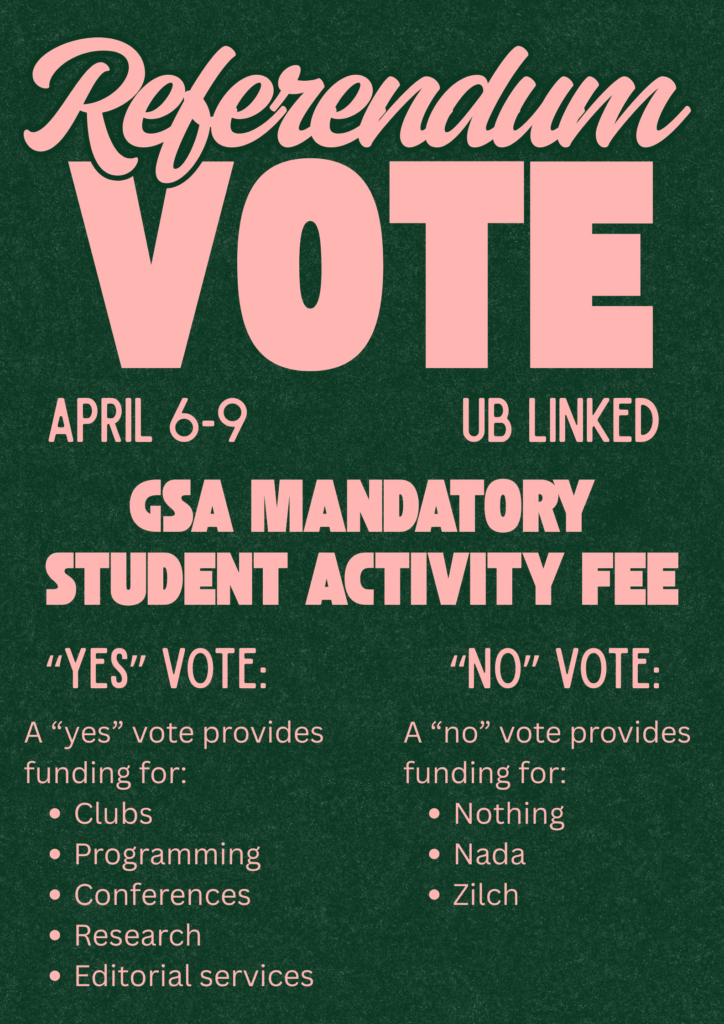
The GSA Officer Elections and Referendum Vote will take place April 6-9, 2026
Every two years the graduate student activity fee is put up for a referendum vote.
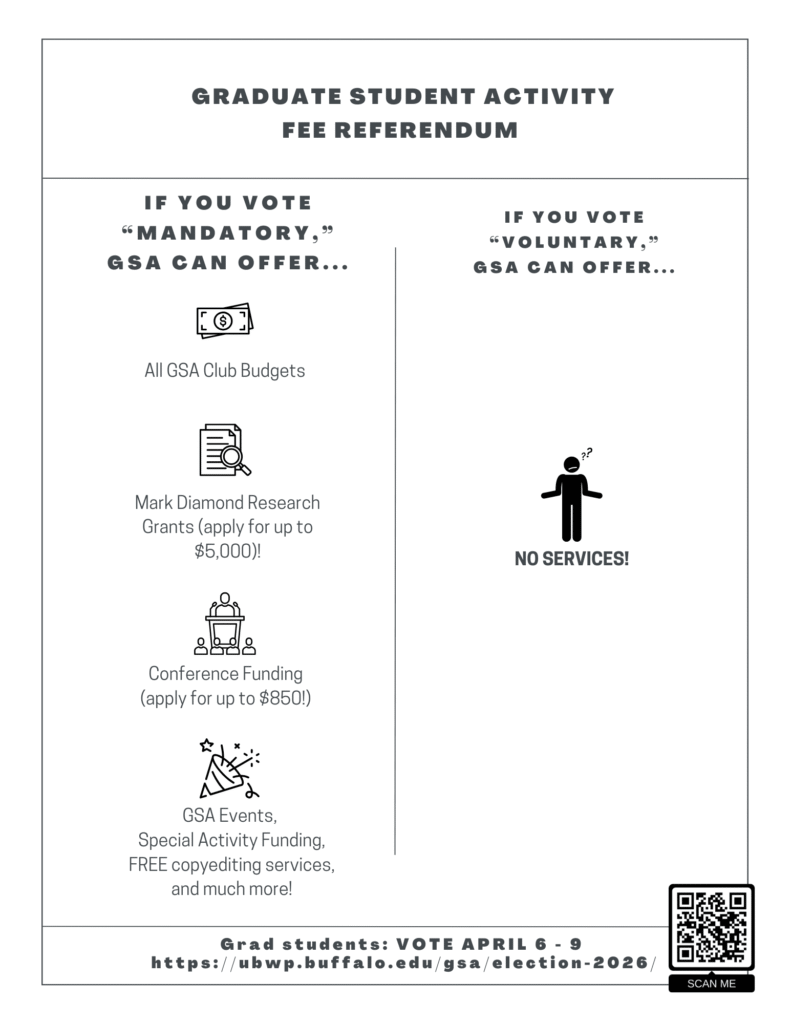
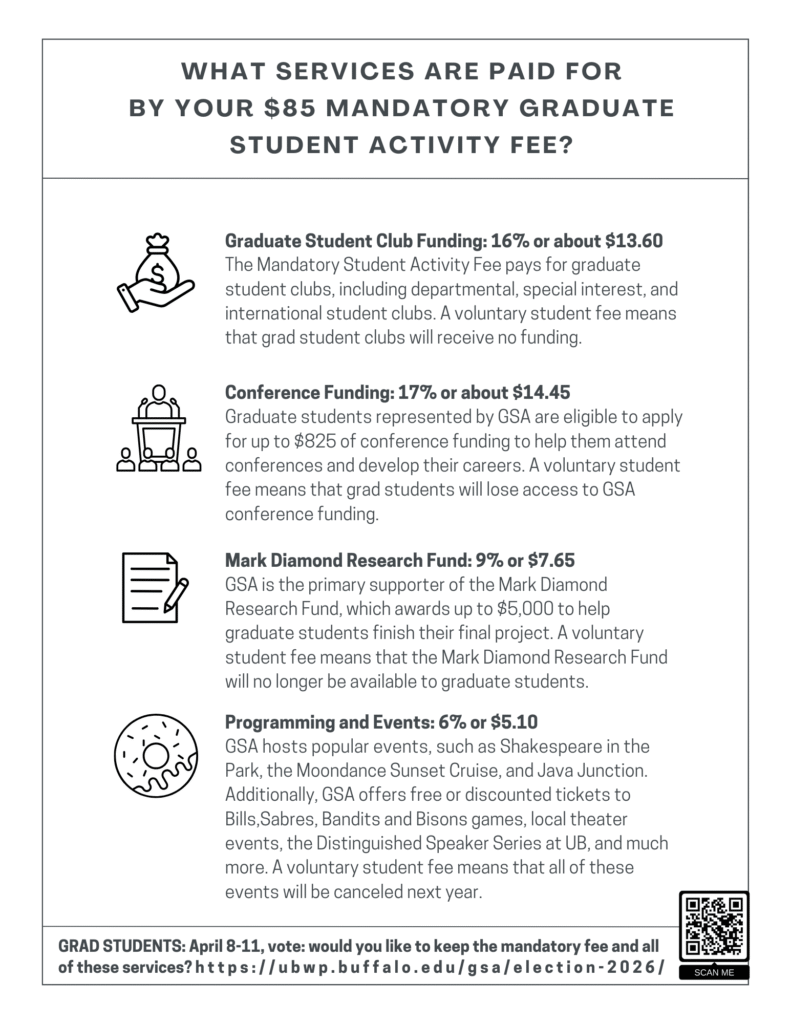
A mandatory fee ensures that GSA is able to continue funding all of the clubs, programs, services and advocacy initiatives you have come to expect from your student government.
A voluntary fee would mean that the organization as a whole would cease to exist.
We hope that you will vote to continue supporting GSA when the referendum vote takes place online April 6th to 9th to coincide with the GSA officer elections.
The Candidates for GSA E-board are as follows:
For President:

Sarah MacDougall
“An engaged student leader who believes in increasing student advocacy and support.”
For the past three years, I have proudly served students as a member of the GSA e-board (two years as Vice President, and one year as President). During this time, I have advocated on behalf of students, created new programming, and helped to make adjustments to GSA funding that have positively impacted more students.
Every month, the GSA e-board meets with the Graduate School. In these meetings, we’ve advocated as a team for greater transparency and communication regarding current events, basic first aid initiatives, tools that would be useful to students who are also parents, and generally conveyed the mood of the graduate student body to upper-level administrators. We’ve weighed in on things like AI policy creation, language testing, and graduate student spaces. We’ve fought for increased solidarity and support for international students. While some of these efforts have been more fruitful than others, the opportunity to raise student concerns with people in power is not one I take for granted.
Since starting my tenure as a GSA officer, I have implemented resource fairs on North and South campus at the beginning of every year so that graduate students new and old can familiarize themselves with the resources UB has to offer. As a result of a student reaching out with an issue, we’ve formulated a strategy and procured funding to provide clubs with first aid and trauma kits in their spaces (or their department spaces, if they don’t have their own space). This year, in response to current events, we are implementing at least three monthly Know Your Rights workshops for students to ask questions about what they’re allowed to do if they encounter ICE, CBP, or other external law enforcement (three of those are scheduled, with a fourth tentatively planned depending on student interest). We have also scheduled a Stop the Bleed training, which will provide students with valuable first aid skills. On the scientific side, we will be hosting a former NSF Program Officer in April to talk about ways to continue to procure funding for the research YOU want to do, despite ever-changing award guidelines.
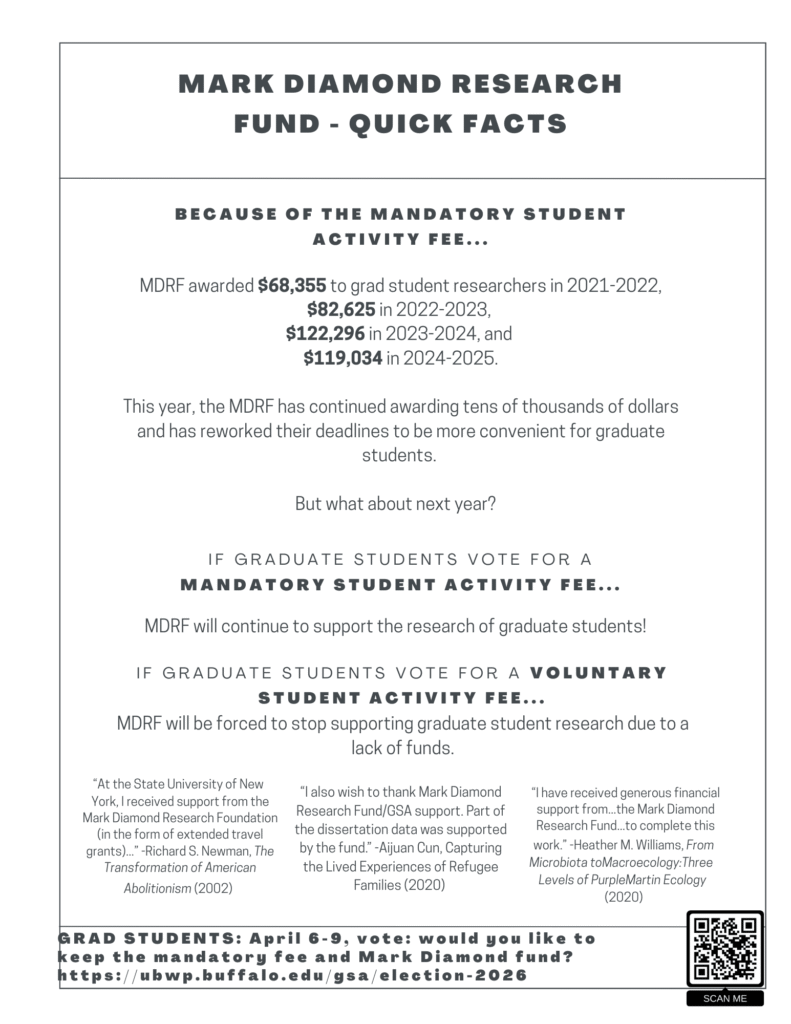
Last year, I worked closely with the Mark Diamond Research Fund Director to restructure the dates for MDRF funding. The goal of this was to make it so that master’s students, many of whom may be relatively new to their disciplines, could have a little additional time to get their research agendas organized for their capstones or theses. As a result, there has been a large increase in the amount of MDRF applications submitted. At the club level, I worked with the GSA Director of Operations to calculate club budget increases in a way that is more equitable, giving every club a base level amount per student, and then applying a percent increase based on size, such that smaller clubs got larger increases and the largest clubs got smaller increases (measured in quartiles). This provided smaller clubs with the opportunity to do more with their budgets, which is a challenge that many larger clubs do not always face, but all clubs saw an increase.
I’ve learned a lot over the past three years, and I would love to take what I’ve learned and seize the opportunity to advocate not only in the ways we have been, but to increase advocacy and programming efforts for students in the humanities, students who are online, and students who work on the medical campus or in Roswell Park Cancer Center, many of whom we represent, but who may feel isolated from their peers on North and South campus. I’ve valued the opportunity to serve students in these ways and hope to continue doing so.
For Vice President:
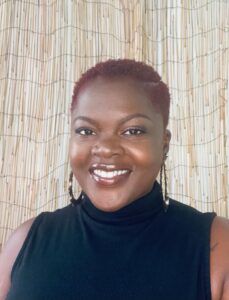
Sherika Caliste
“Value-driven research scientist and student leader with goals to improve outcomes for graduate students.”
Service is at the core of who I am. In high school, I served as a student ambassador, assisting my school with fundraising and enrollment events. During undergrad, I volunteered at various elementary schools in Washington, DC, assisting teachers and staff with afterschool activities. In graduate school, thus far, I’ve co-founded a writing group for graduate students of color and served as treasurer of the GSA’s Graduate Students of Color group. Outside of UB, I held the positions of Vice Chair, Chair, and Past Chair on the student committee at the Society of Personality and Social Psychology (SPSP), where I fostered collaboration among psychology graduate students and faculty to promote development within the field. Currently, I serve as a Board of Directors Member at SPSP. Additionally, I was a dedicated member of Black Love Resists in the Rust (BLRR), a community organization with a mission to improve the self-efficacy and safety of Black communities in Buffalo, NY. That said, ensuring that people feel safe, heard, and taken care of are an integral part of my journey.
In addition to my years of service, my diverse background and interests have guided my desire to serve graduate students at UB. I am a first-generation student of Caribbean ancestry who was born and raised in Harlem, NY. While earning my bachelor’s degree in psychology at Howard University, I became passionate about human behavior and its interconnection to physiological, psychological, and socio-environmental factors. Upon completing my studies at Howard, I began my lifelong commitment of leveraging my education to benefit society at large. During the span of time between my undergraduate and graduate degrees, I worked for various organizations geared towards improving the quality of life for various marginalized groups. As time progressed, my curiosity about the intricate systems of oppression led me to pursue a Master of Social Work (MSW) at the Silberman School of Social Work at Hunter College.
What I value about being a student at UB is the incredible range of services offered to graduate students. As GSA’s Vice President, I will utilize my years of diverse service activities and my social justice background to ensure that all students at UB are connected to resources that will not only enhance their time here, but will set them up for a brighter future outside of UB. I look forward to advocating on behalf of students and student activities on campus.
For Treasurer:

Daniel Kulesza
“Communication PhD student specializing in cognitive science, dedicated to financial advocacy and supporting graduate students.”
I am a PhD student in the Department of Communication at the University at Buffalo, specializing in cognitive science. I research how social identity and perceptions of media influence attitudes toward outgroups and the moral judgements that shape our social world.
I view the role of GSA Treasurer as one rooted in advocacy and structural support. Graduate students already balance research, teaching, coursework, and professional development while navigating complex funding and reimbursement systems. Administrative financial confusion should not be an additional barrier to student success.
I will prioritize responsible stewardship and transparency, working to ensure that budget priorities and funding decisions are understandable and accessible. I will focus on empowering student organizations and initiatives by advocating for funding processes that allow student-led ideas to thrive. Finally, I will work to demystify financial systems so that reimbursements, grant applications, and funding guidelines are clear, consistent, and navigable.
Financial leadership requires clarity, accountability, and a commitment to serving the broader graduate student community. As Treasurer, I will be committed to ensuring that the GSA remains stable, transparent, and responsive to the needs of the graduate student body.
Details concerning election procedure can be found in the 2025-2026 Election Code