

Local politics deals with issues far from the presidential campaign: schools, police, and sanitation. Yet in many states and counties, winning these offices effectively requires running under a party label. Local politicians often insist that their work transcends national partisanship — but do voters see it that way?
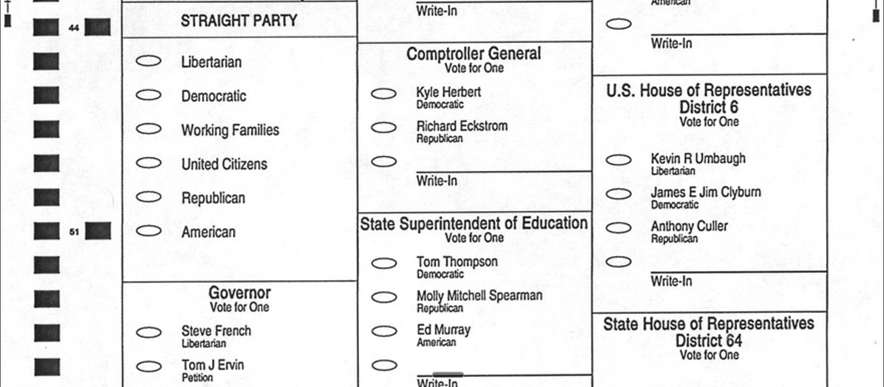
Figure 1: A sample ballot from South Carolina
It is commonly known that places that vote for Republican candidates for President also tend to elect Republican state legislators and Republican state officials. But aggregate election data is not dispositive of the extent of straight-ticket voting. Imagine a hypothetical electorate of 100 people in which 50 vote for a Republican President and a Democratic Sheriff, while the other 50 vote for a Democratic President and a Republican Sheriff. All 100 of them, in other words, are ticket splitters, but the aggregate election result will be indistinguishable from one in which all of them were straight ticket partisans.
Perhaps researchers could survey voters and ask how they voted. But polls rarely ask about local races, and voters may forget who they voted for, too.
In some jurisdictions, there is a third route: the cast ballots themselves. Once a voter drops off their ballot or a mail-in ballot is separated from its envelope, the vote choices are separated from the voter’s identity and become anonymous (though there are rare exceptions). Jurisdictions sometimes make those ballots available for election transparency, so researchers can observe exactly how an anonymous voter voted. The current article, published in the 2025 issue of the Journal of Politics, was one of the first to systematically examine these patterns throughout the entire partisan ballot.
This article focuses on South Carolina, which, from 2010 to 2018, shared its ballot records on its website. I later analyzed cast vote records from Arizona and Maryland. These ballots, amounting to about 6 million votes, allowed me to count the occurrence of ticket splitting in offices ranging from the President to the county council.
Across these offices, ticket splitting tended to be higher in local elections than in federal congressional elections. In South Carolina, during the time period of study, 90% of voters voted for the same party in the Presidential and US House races. But when voters were voting in a County Sheriff contest between a Democrat and a Republican, the straight-ticket rate was closer to 80%. The remaining voters either abstained, voted for a third party, or split their ticket.
One issue with these simple comparisons is that the set of voters voting in a contested congressional race is different from those voting in a contested Sheriff race. Local elections are dispersed and often uncontested. To overcome this challenge, I used a clustering algorithm that estimates voters’ latent types. Adapting the method to account for uncontested races, I found that, for example, about 36% of 2016 Trump voters belonged to a bloc that voted straight ticket for Congress but split their ticket for state legislature and sheriff. About 1 in 10 Clinton voters were estimated to be anti-Trump Republicans – voting for Republicans across the ballot except for Donald Trump.
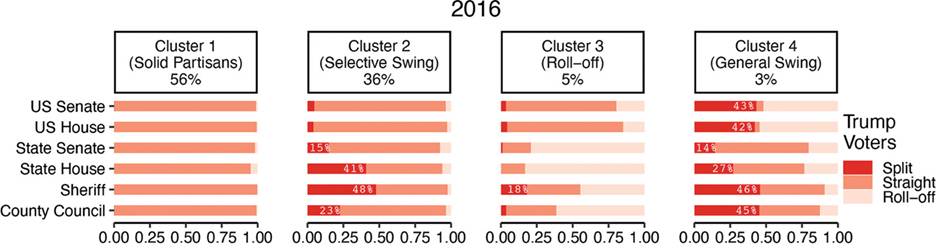
Figure 2. Prevalence of ticket splitting by office
Why, then, is ticket splitting high in some races but not others? To a voter who does not follow politics, Republican candidates for state legislature and Republican candidates for Congress could be identical, so there would be no reason to split their vote. But some voters may have heard a few good things about the longtime Republican sheriff, or their school board member. It may also be the case that the candidates in local offices are more moderate: Despite running under the same party, the local candidate could plausibly distance themselves from Presidential politics. I collect data on how often these candidates are mentioned in state newspapers, how much money they raise, how extreme they are as inferred from the donations they receive, and how often they are endorsed by newspapers. In most of these investigations, the candidate considered higher quality, more well-known, and more moderate tends to benefit from more ticket splitting.
Although it is difficult to disentangle quality explanations from ideological ones (because moderate candidates also tend to be incumbents who also raise more money), these results rule out some stories. For voters to systematically split their ticket towards one local candidate, they must both know something about the local candidate beyond the party label, and they must care enough about that attribute to cross the party line. Although such voters are small in number, they provide a counterexample to the concern that voters do not know enough or that US politics has gotten too polarized for them to care.
Extensions
This article is one of several recent accounts that leverage cast vote records to better understand voter behavior. Other teams have used it to study ideological voting, ranked choice voting, and nonpartisan offices (here and here). Cast vote records have also been investigated in election administration controversies. Based on this work, I have also created an interactive platform to look up ticket splitting for any pair of candidates.
These findings tell us a few substantive things about the role of party affiliation in electoral politics. Nominally partisan elections studied do not mean that candidates must run under a party. The fact that candidates choose to run under the Republican or Democratic banner rather than as Independents suggests an electoral payoff to the party label: it signals shared ideology to copartisan voters and provides access to campaign resources, even if it costs some crossover votes.
This post started out with the observation that many local offices in the United States are elected on partisan ballots, but some are not. What happens when a partisan office becomes nonpartisan? A recent study shows that changing judicial elections to nonpartisan status did not markedly change the candidate pool in terms of experience, but voting became more aligned with the top of the ticket, and roll-off decreased dramatically.
https://www.journals.uchicago.edu/doi/10.1086/734263
Shiro Kuriwaki is an assistant professor of political science and an affiliate at the Institution for Social and Policy Studies at Yale University.