

Local newspapers were once a staple of American political life. Information is the lifeblood of democracy, and newspapers have long been critical providers of information to the public. Founding figures of the American democratic experiment described newspapers as essential for ensuring that government is responsive and accountable: Thomas Jefferson, the principal author of the Declaration of Independence and the nation’s third President, wrote that given a choice between “government without newspapers or newspapers without government,” he “would not hesitate a moment to prefer the latter.” By the middle of the 20th century, the newspaper business enjoyed an incredibly broad readership: the average number of newspaper subscriptions per U.S. household exceeded 1, most of which were for small newspapers that served a limited geographic area.
Today, the newspaper industry is struggling. The average American household now subscribes to about one-fifth of a newspaper. Advertising revenue, on which much of the industry was built, has declined precipitously. Thousands of newspapers across the country have shuttered permanently, most of them local weeklies in communities with few alternatives for local information. Nearly all surviving newsrooms have suffered multiple rounds of deep staffing cuts in the past three decades. Some “ghost newspapers” have no reporting staff left at all, persisting only as rump websites to collect stray pageviews for pennies in ad revenue.
To do their jobs, newspapers (like other mass media) need revenue to pay reporters, editors, and support staff. As the traditional ad-based revenue model faltered after the advent of the Internet, many newspapers implemented online paywalls to supplement traditional print subscription revenue. But these paywalls, which limit potential readers to only a few free articles (or none) before requiring a paid subscription, can also limit potential customers by setting too high a price and pushing them towards cheaper sources of news, like social media.
Amid the alarm over a declining newspaper industry, there has been a recent push among journalists, scholars, and even policymakers to pursue alternative revenue models that could instead make local news free to consume. One approach is through philanthropic support; nearly every U.S. state now has at least one local nonprofit newsroom, and some of these make their coverage free to access. Another is through government-funded support grants, such as those provided by the New Jersey Civic Information Consortium.
An underlying assumption of many of these efforts is that lowering the cost of accessing local news will increase its consumption among the mass public, leading to positive downstream outcomes like increased political knowledge and engagement. But does it?
The Study
To find out, I collaborated with a prominent local newspaper in North Carolina, The News & Observer of Raleigh, to conduct a randomized experiment, making The News & Observer’s online coverage free for some local individuals but not others. I mailed invitations to participate in a research study to random registered voters in North Carolina’s Chatham County, a purple county on the periphery of the state capital (Raleigh). Among those who enrolled in the study by completing an initial survey, I randomly assigned about half to receive a free, two-month digital subscription to The News & Observer during the 2022 midterm election season—a period in which many voters might be more interested in local political information than usual. During the study, The News & Observer tracked how often each treated participant used the free subscription. After the two-month treatment period ended, I administered a follow-up survey to track changes in participants’ political knowledge, engagement, and attitudes.
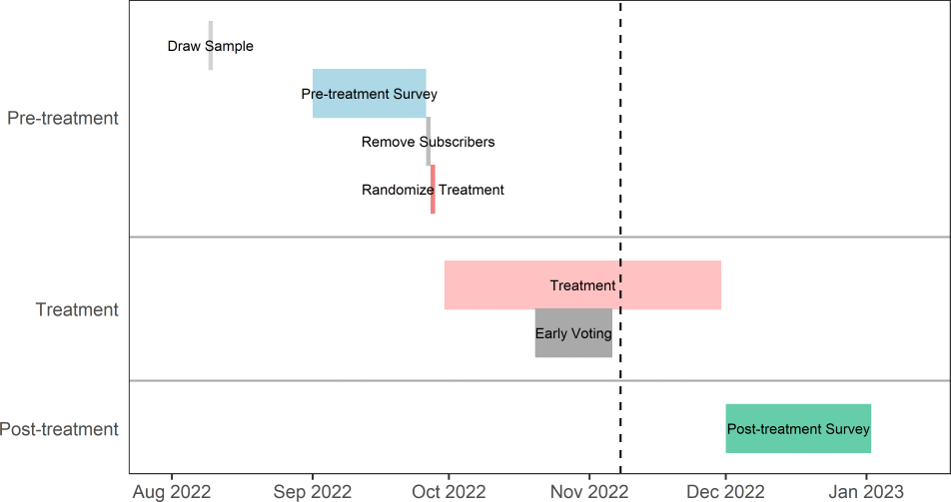
Figure 1. Figure depicts the study timeline. The dashed line indicates election day for the 2022 general election.
The Findings
How many of the treated participants took advantage of the free subscription, defined by simply logging in at least once?
Only 19 people, just 3.8% of the treatment group. Seven of these individuals did nothing more than log in once. Just five individuals accessed The News & Observer’s coverage with their subscriptions 10 or more times over the two-month treatment period. Clearly, making the subscription—valued at around $32 at the time—completely free did little to increase readership.
Given such a low uptake of the free subscription, we could reasonably expect a minimal impact on the pro-democracy outcomes under study. We therefore took a more proactive approach: in addition to providing the free subscriptions, The News & Observer also emailed dozens of newsletters directly to treated participants’ inboxes. Underscoring the low subscription uptake, about one in four treated participants requested to be unsubscribed from the newsletters as well. Still, our tracking data suggests that more than half of the newsletter emails were at least opened, and about half of the treated respondents recalled receiving them in the post-treatment survey. So this more direct provision of local news information could potentially still have some pro-democracy effects.
But in the end, it did not. Across a wide range of outcomes—including local and national knowledge of politics, engagement behaviors like election turnout or contacting an elected official, and political attitudes like trust in the media or support for democratic norms— there was no discernible difference between treated participants and control participants (who received no free subscription and simply completed the surveys).
So if making local news free to consume does not improve these outcomes, why not? And what would actually help? This study cannot answer such questions definitively, but it can offer several clues. For local newspapers to fulfill their normative role in local democracy, they need readers. While the price of access is undoubtedly a barrier to reading for some, this study suggests that it is not the barrier for most. Instead, journalists and scholars need to explore ways to overcome broad public perceptions that local newspapers are low quality and of little relevance. Efforts to make local news information more accessible to casual consumers and to develop deeper connections with local audiences may yield better results than simply removing the price barrier.
https://www.journals.uchicago.edu/doi/abs/10.1086/735872?af=R
Andrew Trexler
Assistant Professor of Political Science at the University of Wisconsin-Madison