

In recent years, voting by mail has been the subject of numerous lawsuits and attacks that often claim the process gives Democratic nominees and legislative bills an edge. Are there merits to this claim, and what are the actual causal effects of sending ballots to all registered voters? In the paper, we take advantage of a unique situation in Southern California that allows us to pin down the causal effects convincingly.
A unique situation in Southern California provides a golden opportunity to identify the causal effects
While absentee voting by mail has been an opt-in option—mostly for the armed forces—for more than two centuries, COVID-19 spurred a shift toward universal and “no-excuse” vote-by-mail policies in many states. Oregon, Washington, Colorado, Hawaii, and Utah had enacted universal voting by mail before 2020, and four more states—California, Nevada, New Jersey, and Vermont—sent mail ballots to all registered voters for the November 2020 general election.
Even prior to the pandemic, California was expanding its mail-in voting policies to make it easier for people to vote by mail. In early 2020, we were working with California’s secretary of state when they came across an interesting provision in California’s 2018 Voter’s Choice Act (VCA). The provision required that Los Angeles County send mail-in ballots to all registered voters living in parts of the county represented by congressional or state legislative districts that overlapped with neighboring Orange County, where universal voting had been rolled out as part of the VCA.
The VCA allows counties to be more flexible in how they conduct elections by offering options such as mailing ballots to every voter and expanding in-person early voting. By the start of 2020, select counties, including Orange County, had already fully implemented the VCA. To keep the consistency of this practice within the congressional districts and state legislative districts for the 2020 primary, Los Angeles County was also required to mail ballots to voters in the county who live in districts that also span Orange County, while the majority of voters in Los Angeles did not automatically receive a ballot by mail (Figure 1). This unique within-jurisdiction situation provides a golden opportunity to investigate how voter turnout was affected when all registered voters automatically received a mail-in ballot.
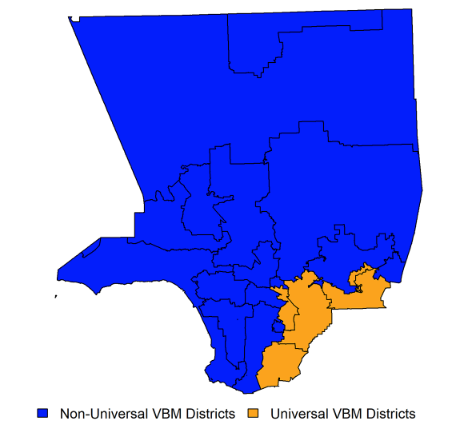
Figure 1. Districts with and without universal vote by mail (VBM) in Los Angeles County.
Applying appropriate causal inference techniques to exploit the within-jurisdiction variations
To estimate the causal effects of sending ballots to all registered voters, we use difference-in-differences and geographic boundary-based designs using individual-level records. Specifically, in our difference-in-differences analyses, we compare voters residing in universal vote-by-mail districts (the treatment group) to those living in nonuniversal vote-by-mail districts (the control group) with respect to their turnout in 2020 (after the policy was implemented) relative to 2016 (before the policy was implemented). We conduct the difference-in-differences analysis for nonpermanent and permanent absentee voters separately, because permanent absentee voters received mail ballots automatically, regardless of the policy under consideration, and were not directly affected by it.
In addition to the difference-in-differences analyses, we also utilize geographic boundary-based designs on geocoded individual records. Specifically, we geolocate all registered voters in Los Angeles County and conduct a geographic boundary-based regression discontinuity analysis using the distance to the boundary as the running variable. By focusing on the causal effects on voters residing close to the boundary, the regression discontinuity analysis provides us a way to control for remaining confounding factors in our difference-in-differences analysis.
Our study has strong internal validity, overcoming several weaknesses in previous studies employing cross-county or cross-state variation. First, there is considerable variation across counties in election administration, political competition and culture, and social and demographic composition, which could produce unobserved confounders and bias the estimates. Second, because counties usually have discretion over when or whether to implement universal voting by mail, implementation is correlated with observable and unobservable county characteristics and past turnout, which could lead to endogeneity and omitted variable bias. Finally, universal voting by mail was typically implemented as part of a package of reforms, including the elimination of neighborhood polling places and the use of extended pre-election voting periods, making it difficult for these studies to isolate the treatment effect of universal voting by mail. By focusing on a single jurisdiction (Los Angeles County), we found little variation beyond universal voting by mail between the treatment and control groups in our study.
Causal effects of universal mail ballot delivery
In the paper, we show that sending a ballot to every registered voter increased voter turnout by 3-4 percentage points among voters who had not previously received a mail ballot automatically. A 3-4 percent increase in turnout is substantial, especially compared to other factors that political scientists have studied; TV advertising, for example, has been shown to have almost zero impact on turnout. Although turnout among female and male voters is equally boosted by universal voting by mail, the policy has a larger effect on older voters than on younger voters, and a larger effect on racial minority voters, especially Hispanic and Asian voters, than on White voters.
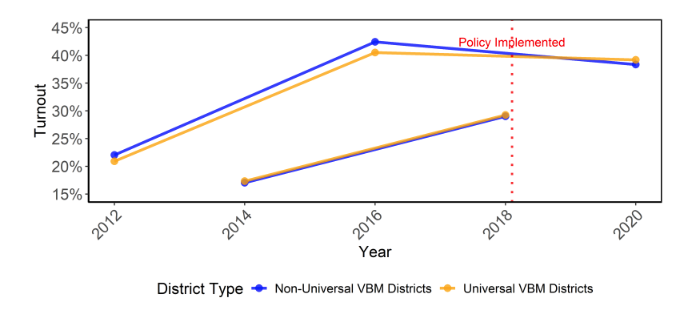
Figure 2. Voter turnout in universal and non-universal vote-by-mail (VBM) districts in Los Angeles County.
Importantly, we also show that this causal increase in voter turnout is generally larger for registered partisan voters than for registered voters without a party affiliation. Moreover, contrary to a common narrative, our causal evidence suggests that universal mail ballot delivery does not benefit Democrats more than Republicans—a result that should interest legislators and policymakers on both sides of the aisle.
Our research has important policy implications. While many states have made voting easier for registered voters following the COVID-19 pandemic, we have also seen other states move to restrict many “convenience” voting measures. Our results indicate that universal voting by mail is likely to increase voter turnout, suggesting that states seeking to boost turnout may consider moving toward it. Conventional wisdom these days is that such reforms have a partisan advantage, but we find that’s not true. Convenience voting reforms, like sending mail ballots to all registered voters, are things policymakers can easily implement that help boost participation in democracy and don’t have any clear partisan ramifications.
https://www.journals.uchicago.edu/doi/abs/10.1086/736867?journalCode=jop
R. Michael Alvarez is the Flintridge Foundation Professor of Political and Computational Social Science and the co-director of The Ronald and Maxine Linde Center for Science, Society, and Policy (LCSSP) at California Institute of Technology.
Yimeng Li is a postdoctoral scholar at Florida State University.