

People are interested in political distrust because we normally assume that it is caused by poor government performance and that it has negative consequences, especially for political participation. In this paper, we challenge these two assumptions.
Political trust: beyond the running tally
Both assumptions rest on the idea that trust is a ‘running tally’. People see the performance of the government, whether economic, policy, or procedural, and then adjust their level of trust depending on whether that performance is good or bad. This affects participation because, as trust changes, so does people’s willingness to participate in a system that is more or less trusted.
But that is only one way to conceptualize the causes of trust and the relationship between trust and participation. Trust could also be socialized in early life, or be dispositional and mainly affected by our genes. In both cases, trust is less likely to change in response to events, and any correlation between trust and participation is less likely to imply a causal relationship. The second point is that early environments and inherited traits may provide a common cause of political trust and political participation.
The origins of political trust
This is all well and good, but how do we empirically test this? Standard public opinion surveys tend not to measure socialized or dispositional contributions to our political attitudes, and even when they do, these contributions are often highly correlated, making them extremely difficult to separate.
In our paper, therefore, we take a different approach. We use data from four twin studies (two in the US, one in Sweden, and one in Australia). We know that twins share a substantial proportion of their early environment and inherited traits, even if we have not measured these factors directly. This means we can use known correlations in early environments and inherited traits in (identical and non-identical) twin pairs to estimate their contributions to political trust.
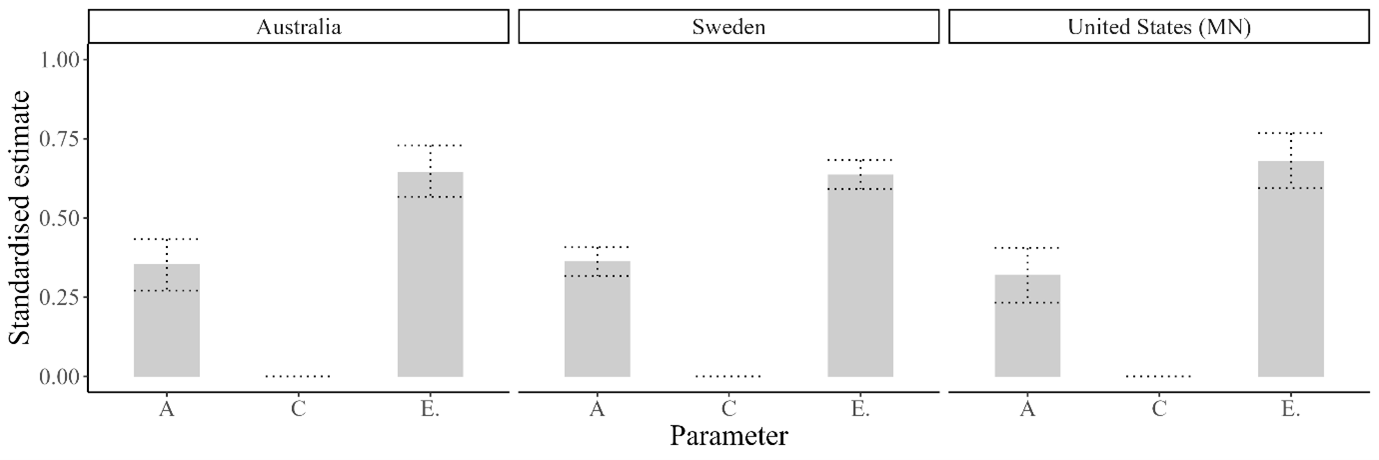
That’s what we’ve done in Figure 1, which shows the estimated contributions of inherited traits (A), early shared environments (C), and other factors (E) to trust. About 35 percent of the variation in political trust is attributable to inherited traits. Given the assumptions of these models, this is likely to be a conservative estimate. We should also note that the C component is also likely to be underestimated, as early environments are probably partly reflected in the E component.
Figure 1. Variance decomposition models for political trust.
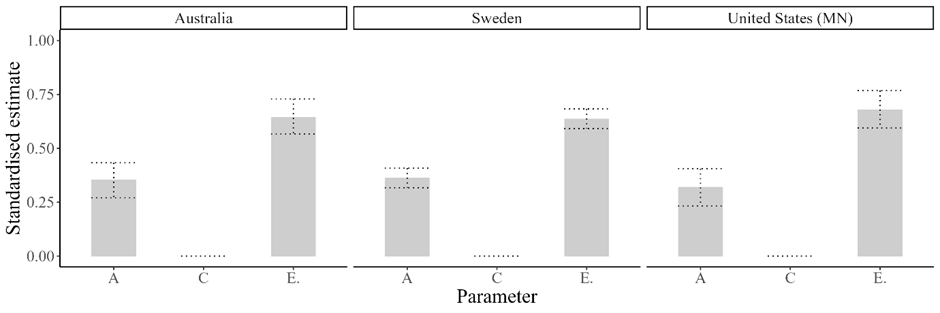
Note. Point estimates and 95 percent confidence intervals for the univariate twin decomposition models.
Political trust and political participation
What does this mean for political participation? Normally, unmeasured early-life factors might account for the commonly observed correlation between political trust and political participation. Using the twin data, we can account for this by adding a control variable for each twin pair. In Figure 2, we compare naïve and adjusted estimates of the relationship between trust and participation in two of the twin datasets. Larger values indicate a stronger estimated relationship, and the error bars indicate the range of plausible values in each model. In both cases, the relationship falls substantially within the fixed-effects model, and in the Minnesota case, it is no longer distinguishable from zero. Previous estimates of the relationship between political trust and political behavior are therefore overstated.
Figure 2. The effects of political trust on political participation.
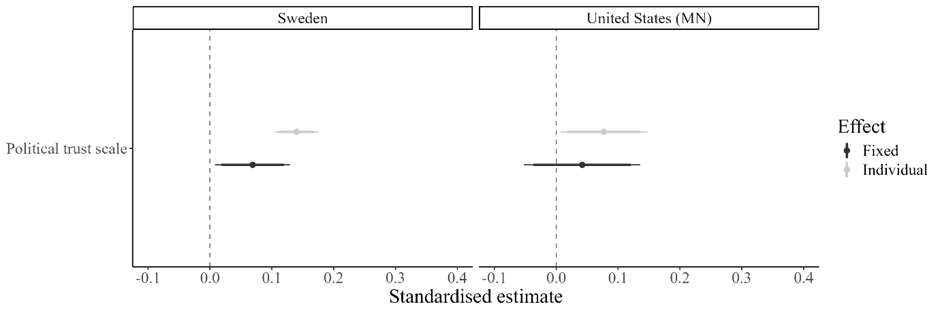
Note. Point estimates (in standard deviations), 95 percent confidence intervals (thin lines), and 90 percent confidence intervals (thick lines) for the co-twin models predicting political participation with political trust.
What does this mean?
Overall, our results suggest that an important component of political trust reflects an underlying disposition rather than an evaluation of current political events. This helps us understand why trust tends to be so stable over time. It also affects how we should understand the potential consequences of trust. We find very limited support for trust as an important cause of participation, despite policy makers and academics regularly invoking low trust as a problem for political engagement.
Our study also opens other avenues for further research. Which specific early life factors are most important for political trust? In particular, what are the dispositions that are being inherited, and do they map onto known personality traits? And, more generally, what other assumed causes of political participation are simply correlational rather than causal?
Edmund Kelly, James Tilley, and Sven Oskarsson.
https://www.journals.uchicago.edu/doi/10.1086/736338
Edmund Kelly is a PhD student in the Department of Politics and International Relations at the University of Oxford. He researches public opinion and political behavior in democracies, focusing on political distrust and research reproducibility. His work has appeared in outlets including Nature, The Journal of Politics, and the British Journal of Political Science.
James Tilley is a Professor of Politics at the University of Oxford and a Fellow of Jesus College, Oxford. His research focuses on public opinion, electoral behavior, and British politics. He has written several books, most recently Tribal Politics: How Brexit Divided Britain with Sara Hobolt (OUP, 2026).
Sven Oskarsson is a Professor of Political Science at the Department of Government, Uppsala University. His research focuses on political behavior and sociogenomics. His work has appeared in several outlets, including Nature, American Political Science Review, American Journal of Political Science, and Political Analysis.