
NSF CAREER (Award #2441363)
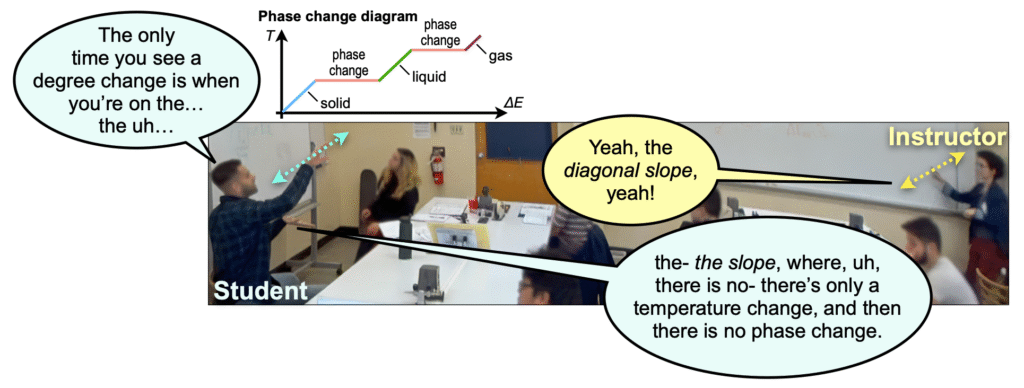
In STEM education, students’ learning outcomes are highly contingent on the quality of instruction they receive. Previous research has shown that responsive teaching – instructors’ efforts to elicit, attend, and respond to the substance of students’ ideas and to connect those ideas with the discipline – has profound impacts on students’ STEM learning. To date, research on responsive teaching has primarily been limited to communication processes that occur in speech, despite the well-established role that gesture and other nonverbal, embodied communicational resources play in how students convey their ideas about STEM phenomena. This project is the first of its kind to investigate embodied responsive teaching in science by examining how physics instructors elicit, attend, and respond to nonverbal aspects of students’ ideas in the classroom and how these interactions impact students’ physics learning. From this investigation, professional development materials will be developed to educate STEM instructors on how to more effectively leverage students’ use of gesture and nonverbal communication in the classroom to support their learning. By better understanding the role nonverbal communication plays in instructor-student interactions in undergraduate STEM courses, this CAREER project will contribute to more effective STEM education and STEM educator development.
Drawing on an existing video corpus of instructor-guided collaborative learning activities in an undergraduate physics course, this project will use multimodal conversation analysis and the Co-Operative Action framework to investigate: (1) how undergraduate students use embodied communicational resources to convey ideas about physics in small-group and whole-class discussions; (2) how instructors use embodied responsive teaching (ERT) to elicit, attend to, and respond to students’ ideas conveyed through gesture and other embodied communicational resources; and (3) how ERT supports and/or constrains students’ engagement in scientific practices and their development of conceptual understanding in physics. The integrated educational plan will adapt the findings of this research into video-based professional development modules for training undergraduate STEM instructors and pre-service secondary STEM teachers, which will be disseminated widely through the existing web-based platform Periscope. This project contributes to the improvement of undergraduate physics education and STEM education by generating a better understanding of the instructional practices that support students’ physics learning and participation. In addition, it will contribute the first widely available video-based professional development lessons to strengthen STEM educators’ understanding of representational gesture in students’ scientific sensemaking.