

One of the strongest findings in political behavior research is that people often take cues from their party when forming opinions. If their party supports a proposal, they are more likely to support it too. If the opposing party supports it, they often move the other way. In a polarized age, that pattern matters. It suggests that citizens may sometimes respond less to what a policy does than to who backs it.
My recent article asks a simple but important question: Can this partisan bias be reduced by making people aware of it?
The answer is cautiously encouraging. In some cases, yes.
Why party cues are so powerful
Most people do not have the time to study every policy issue in detail. So they rely on shortcuts. One of the most powerful shortcuts is the party cue: a signal that Democrats or Republicans support or oppose a policy. That shortcut can be useful. It helps citizens navigate a complex political world.
But it can also distort judgment. A voter may end up backing a policy not because of its substance, but because it carries the label of their preferred party. In that sense, partisan bias is not simply strong disagreement. It is the tendency to judge a proposal through partisan attachment rather than through the policy itself.
That matters for democracy. When citizens react mainly to party endorsements, parties gain more power to shape opinion regardless of policy content. Accountability becomes weaker. Public debate becomes shallower. And voters may support positions they would not have chosen under more careful reflection.
Testing a modest intervention
To study whether this bias can be softened, I ran an online survey experiment with 798 U.S. adults. Participants were asked about eight policies, ranging from high-profile issues such as health care and the minimum wage to lower-salience administrative and budgetary reforms. Some people were shown party cues about which party supported the policy. Others were not. Some also received a short warning message.
That warning did not tell people what to think. It simply encouraged them to reflect on their thinking. Participants were told that parties sometimes support policies their own voters might not support if they considered the policy more carefully, and that relying too heavily on party endorsements can be misleading.
This kind of prompt draws on the idea of metacognition, which is a technical term for thinking about one’s own thought process. The intervention was designed to make people pause before automatically following the party label.
What changed and what did not
The first result will not surprise many observers of American politics: party cues worked. Democrats and Republicans were more likely to support policies when told that their own party endorsed them. In some of the less visible policy areas, those cues were strong enough to flip the partisan majority supporting a proposal.
But the second result is the more interesting one.
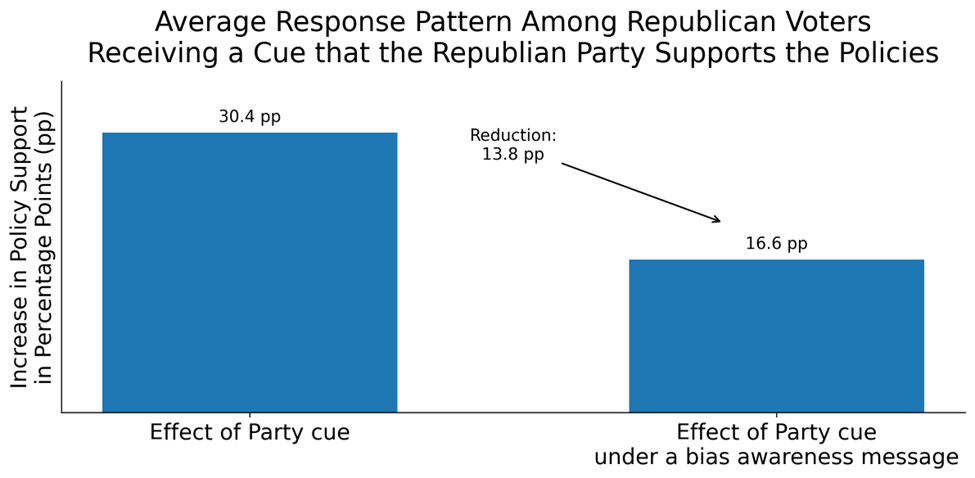
When people were warned that party cues can bias judgment, the effect of those cues weakened in some cases. Among Republican partisans, the effect of a cue saying that Republicans supported a policy fell by 13.8 percentage points. Among Democratic partisans, the equivalent reduction was 6 percentage points, though that estimate was statistically more modest.
This does not mean partisan bias disappeared. It did not. It means that a brief reminder to reflect on one’s own reasoning was enough to reduce the pull of the party signal under some conditions.
At the same time, the effects were uneven. The intervention did not significantly reduce partisan bias across every cue condition. So this is not a magic fix, and it should not be presented as one.
Why the mixed results still matter
The fact that the intervention worked only in some cases is part of what makes the finding important.
It suggests that partisan bias is not driven by a single mechanism. Sometimes voters may use party cues as a convenient shortcut when they lack information. In those moments, a warning may prompt them to think more carefully. But in other cases, partisan identity may be doing more of the work. When that happens, people may stick with their side even after being reminded that the shortcut can mislead them.
Even so, the study found evidence that the warning changed how participants take party cues. People exposed to the message became less confident that they could infer what a policy was about just by seeing which party endorsed it. That is a meaningful shift. It suggests that citizens can be nudged to become more skeptical of partisan shortcuts, even if not all cue effects disappear.
A democratic lesson
In an era of intense polarization, it is easy to assume that partisan bias is immovable. This study points to a more nuanced conclusion.
Party cues remain powerful. But they are not always unbeatable. A simple intervention that encourages citizens to reflect on their own susceptibility to partisan bias can sometimes weaken its effects.
That is not a cure for polarization. But it is a reminder that democratic judgment in contexts of strong party attachments may be more flexible than it appears. Even in a highly partisan environment, asking people to slow down and reflect on how they think may help them judge policies a little less as partisans and a little more as citizens.
Diogo Ferrari