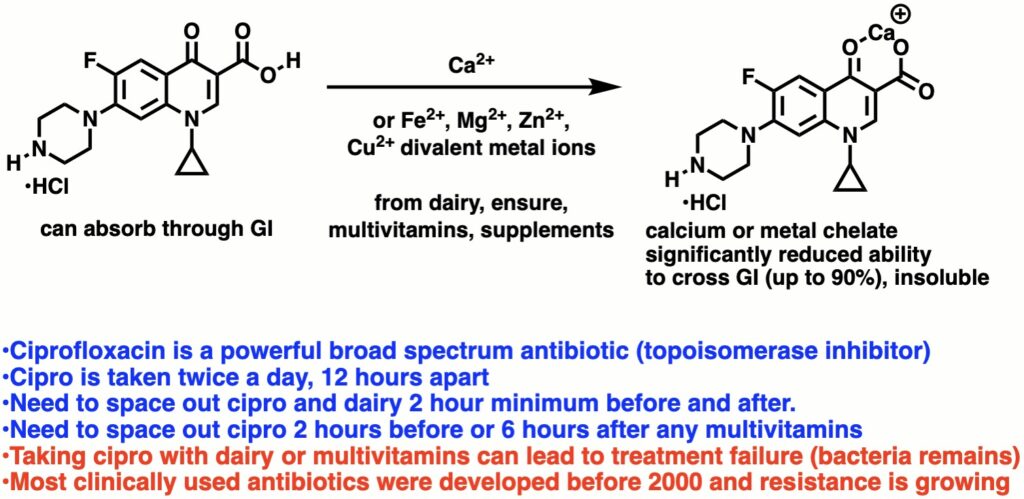
- Approximately 50% of prescription drugs are taken incorrectly (1). One overlooked reason for growing antibiotic drug resistance is improper drug adminstration. Some antibiotics, e.g. ciprofloxacin (below) can fail if you take them with dairy, antacids, or multivitamins (2-4). (Refer to the prescription package insert.)
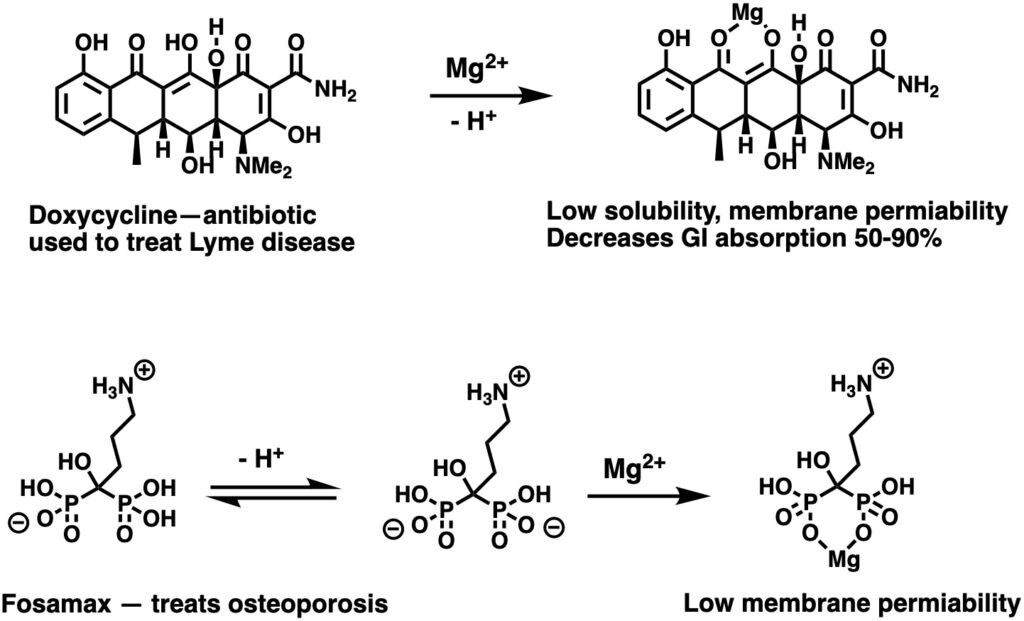
Metal chelation (from dietary sources, as above) also impacts oral absorption of tetracyclines and bisphosphonates, among other medicines.(5-8)
The mechanism of action of these compounds in bacteria killing actually involves their metal (Mg2+) coordination in the respective enzyme active sites.(9) The GI drug delivery problem is one of oral administration.
References: (1) Int. J. Clin. Pharm. 2023, 45, 1359. doi: 10.1007/s11096-023-01626-5; (2) Drug Metab Pharmacokinet. 2014, 29, 414-8; (3) J. Chemother. 1995, 7, 126-32. doi: 10.1179/joc.1995.7.2.126; (4) Antibiotics, 2019, 8, 108; (5) Antibiotics, 2023, 12, 1152. https://doi.org/10.3390/antibiotics12071152; (6) Foods 2021, 10, 720. https://doi.org/10.3390/foods1004720; (7) ADMET & DMPK, 2020, 8 (2), 129-138; (8) Sulli, M. M., Ezzo, D. C., Drug Interactions with Vitamins and Minerals, U.S. Pharm. 2007, 1, 42-55. (9) Njardarson and Tomat, Bidentate Metal-Binding Motifs in US FDA Approved Small Molecule Drugs, J. Med. Chem. 2026, ASAP https.//doi.ogr/10.1021/acs.jmedchem.6c01319.
2. Broad spectrum antibiotics are life saving medicines. Between 50-60% of patients in the hospital receive them.(1) They can also cause gut dysbiosis. Dysbiosis is an imbalance of the intestinal microbe mix, typically made up of many species of bacteria along with fungi and viruses. When one or a few microbes become too abundant while others are killed by the antibiotics, the resulting condition is dysbiosis. Some of the overabundant microbes are even pathogenic, e.g. C. diff., which makes a toxin that can severely injure the colon (https://cdiff.org). These perturbations typically involve local intestinal inflammation, resulting in gastrointestinal symptoms. Dysbiosis can result in food sensitivities or intolerance (primarily carbohydrates), a common condition following an antibiotic prescription. Antibiotic-induced dysbiosis symptoms can last up to two years! Dysbiosis is also associated with gastrointestinal conditions such as Irritable Bowel Syndrome (IBS), a functional GI disorder, as well as Inflammatory Bowel Diseases (IBD), which are immune-mediated. These are conditions that impair digestion and significantly impact quality of life and overall health. There is some correlation between antibiotic use and the development of IBS and IBD.(2) The antibiotics most associated with dysbiosis include clindamycin and ciprofloxacin (fluoroquinolones in general) and antibiotics that target anaerobes.(2-8) According to some studies, not all antibiotics are associated with long-term dysbiosis.(5,6,7) Penicillins like amoxacillin, for example, are associated with far less disruption.(5,7)
References: (1) OFID Oral abstracts 2891, 2019, “Trends in Inpatient Antibiotic Use in US Hospitals, 2012-2017, (2) Gut, 2023, 72, 663-670. doi: 10.1136/gutjnl-2022-327845 (3) Ther Adv Infect Dis, 2023, 10, 1-18. doi: 10.1136/gutjnl-2022-327845.; (4) Front. Cell. Infect. Microbiol. 2025, 15, 1608025. doi: 10.3389/fcimb.2025.1608025 (5) Nature Medicine, 2026, 32, 1351-1361. doi: 10.1038/s41591-026-04284-y (6) ACS Infect. Dis. 2020, 6, 2544-2559. doi: 10.1021/acsinfecdis.0c00036. (7) Lancet Respiratory Medicine, 2025, 13 (1), 92-100. (8) J. Vet. Intern. Med. 2020, 34, 1853-1866.
3. Despite the high use of antibiotics in US hospitals, only 2.6% of patients are given probiotics in the hospital setting.(1) Probiotic supplements, fermented foods such as kefir (lactose-free versions are available) and natural fiber supplements such as psyllium husk are sometimes recommended by healthcare professionals to mitigate dysbiosis.(2-8, 10, 11) In particular, yeast probiotics are not killed by antibacterial antibiotics. Probiotics are thought to help maintain a healthy gut environment during antibiotic treatment by outcompeting pathogenic bacteria for resources. Gastroenterologists are consulted for individual optimization and treatment plans, and probiotics may not be recommended for some, e.g. infants, immunocompromised individuals, the elderly (>80 years old), patients on intravenous nutrition and severely ill patients (ICU).(9) However, recent studies of ICU(10) and colon cancer surgery(11) patients, respectively, found that patients benefitted from kefir, a fermented food with higher probiotic amounts than yogurt and from other bacterial probiotics.(11) The FDA regulates dietary supplements and probiotic foods as food rather than medicine. Food and supplements have not been evaluated by the FDA to diagnose, treat, cure or prevent any disease. Therefore, their potential use for gastrointestinal conditions should be undertaken under the guidance of a gastroenterologist.
References: (1) Am. J. Infect. Control. 2016, 44 (5), 548-553. (2) https://cdiff.org. (3) Clinical use of psyllium husk in the treatment of irritable bowel syndrom, ulcerative colitis, and colorectal cancer. Gastroenterology Rev 2024, 19 (4), 121-126. (5) Recent advances in the modulatory effects of kefir on the gut microbiota. Explor Foods Foodomics 2025, 3, 1010107. (6) Saccharomyces boulardii prophylaxis for targeted antibiotics and infectious indications to reduce healthcare facility-onset Clostridioides difficile infection. Microbes and Infection 2023, 25, 105041. (7) Managing Gut Dysbiosis: Clinical Evidence and Perspectives on Saccharomyces boulardii CNCM I-745 for Diarrhoeal Conditions in Adults and Children, Microorganisms, 2026, 14, 150. (8) https://www.salemhealth.org/docs/default-source/default-document-library/probiotic-fyi-to-common-ground-and-tip-sheet-2018-3-8.pdf?sfvrsn=6450079c_0 (9) Infectious Diseases Now, 2021, 51, 293-295. (10) BMC Medicine, 2024, 22, 80. (11) J. Surgical Res. 2025, 312, 163-176. (12) Balancing act: counteracting adverse drug effects on the microbiome, Trends in Microbiology, 2025, 33, 268-276.
4. Despite mitigation efforts concurrent with antibiotic treatment, depending on the antibiotic prescribed, the number of different antibiotics prescribed, the duration of use and person-specific reactions, symptomatic dysbiosis can still occur. In cases that do not involve C. diff. infection the symptoms might be managed with diet, fiber and probiotics, under the guidance of a gastroenterologist. The management is not very different from treatment of IBS, but the prognosis is usually better (a temporary condition).
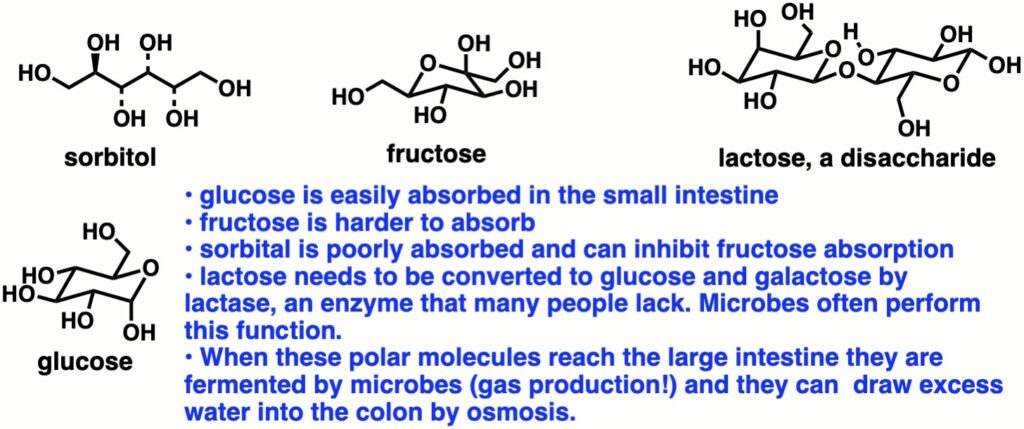
5. A dietary regime to reduce carbohydrate sensitivity symptoms is the low FODMAP diet, which focuses on reducing levels of hard to digest sugars like lactose, fructose and sorbitol (see below).(1, 2) FODMAP stands for Fermentable Oligosaccharides, Disaccharides, Monosaccharides, And Polyols. Doctors at Montash University in Australia (montashfodmap.com) developed the diet to help navigate carbohydrate-containing foods. The diet involves initial elimination followed by gradual re-introduction of individual high FODMAP foods. For example, restaurant pizza might be saved till the end of the reintroduction phase as it contains several FODMAPS (lactose, fructose and fructans), and it also contains gluten, which some people are sensitive or intolerant of. If dysbiosis is resolved, these foods will eventually be edible without causing significant digestive distress. If a remaining food sensitivity is identified, only foods containing that FODMAP are minimized (e.g. many adults are lactose sensitive).(1, 2)
References: (1) Gibson, P. R.; Sheperd, S. J. Personal view: food for thought—western lifestyle and susceptibility to Crohn’s disease. The FODMAP hypothesis. Aliment Pharmacol Ther. 2005, 21 (12), 1399-1409. (2) montashfodmap.com
6. Bonus fact: Heavy metal exposure through the environment, food and water can also cause gut dysbiosis and associated gastrointestinal symptoms.(1) Heavy metals include lead, cadmium, arsenic, mercury and chromium.
Reference: (1) Ghosh et al. Effects of heavy metals on gut barrier integrity and gut microbiota, Microb Host, 2024, 2, e230015.
7. Bonus fact 2: While penicillin class antibiotics are associated with the least amount of gut microbe disruption, approximately 10% of the U.S. population has a reported penicillin allergy.(1) Recent studies have shown most of these “allergies” are not real allergies. To become eligible to receive a penicillin antibiotic again, a person can “challenge” the penicillin allergy with the help of an allergist.(1) This can enable the person to avoid more disruptive antibiotics, especially when the prescription is empirical or when a penicillin is one of the antibiotic options that can treat a known pathogen.
Reference: (1) Madapoosi et al., Penicillin Allergy Testing with Direct Oral Challenge in Primary Care, J. Am. Board Fam. Med. 2024, 27 (6), 991-995.