
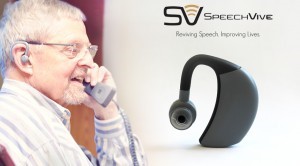
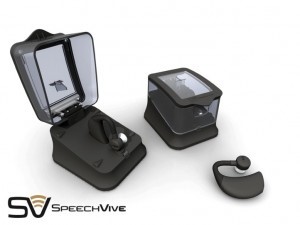
Current speech therapy for people with Parkinson disease focuses on increasing loudness, slowing rate, and improving speech clarity. Often it is difficult for people with Parkinson disease to remember to use speech therapy techniques during everyday communication environments. Dr. Huber developed and tested a device-driven solution to these problems, inventing the SpeechVive device. When a person wears the device, they hear noise in one ear when they are speaking. The noise elicits an automatic reflex called the Lombard Effect, causing the speaker to talk louder, clearer, and at a more typical rate. The device can be worn throughout the day so that people with Parkinson disease can obtain better communication effectiveness in their everyday life.
Published Studies
- Richardson, K., Huber, J.E., Kiefer, B, Kane, C., and Snyder, S. (2022). Respiratory responses to two voice interventions for Parkinson’s disease. Journal of Speech, Language, and Hearing Research, 65, 3730-3748. doi: 10.1044/2022_JSLHR-22-00262 https://pubmed.ncbi.nlm.nih.gov/36167066/
- Richardson, K., Huber. J.E., Kiefer, B., and Snyder, S. (2022). Perception of physical demand, mental demand, and performance: A comparison of two voice interventions for Parkinson’s disease. American Journal of Speech-Language Pathology, 31, 1963-1978. doi: 10.1044/2022_AJSLP-22-00026 https://pubmed.ncbi.nlm.nih.gov/35858264/
- Matheron, D., Stathopoulos, E.T., Huber, J.E., Sussman, J. (2017). Laryngeal aerodynamics in healthy older adults and adults with Parkinson’s disease. Journal of Speech, Language, and Hearing Research, 60, 507-524. https://pubmed.ncbi.nlm.nih.gov/28241225/
- Richardson, K., Sussman, J.E., Stathopoulos, E.T., and Huber, J.E. (2014). The effect of increased vocal intensity on interarticulator timing in speakers with Parkinson’s disease: A preliminary analysis. Journal of Communication Disorders, 52, 44-64. https://pmc.ncbi.nlm.nih.gov/articles/PMC4293242/
- Stathopoulos, E.T., Huber, J.E., Richardson, K., Kamphaus, J., DeCicco, D., Darling, M., Fulcher, K., and Sussman, J.E. (2014). Increased vocal intensity due to the Lombard effect in speakers with Parkinson’s disease: Simultaneous laryngeal and respiratory strategies. Journal of Communication Disorders, 48, 1-17 (PMID: 24438910). doi: 10.1016/j.jcomdis.2013.12.001 https://pubmed.ncbi.nlm.nih.gov/24438910/
Ongoing Studies
Efficacy of a home-based treatment paradigm, EMST and SpeechVive, to improve communication in Parkinson Disease (in collaboration with Michelle Troche at Columbia University): We provided combined treatment using the SpeechVive device and the expiratory muscle strength trainer, EMST-150 from Aspire Products in a small sample of people with Parkinson disease. The data are being analyzed from this study.
A comparison of two vocal intensity treatments for speakers with Parkinson Disease (in collaboration with Kelly Richardson at Medical University of South Carolina):
This study compared use of the SpeechVive device and the Lee Silverman Voice Treatment Program (LSVT-LOUD) in a randomized controlled trial. Two papers have been published and two more are underway.
The long-term impact of the SpeechVive device in people with Parkinson disease: This study examined the use of the SpeechVive device over 9 months in people with Parkinson disease. We considered changes to sound pressure level, speech rate, and respiratory function during speech production. The paper resulting from this study is being prepared.
A Comparison of In-person and Telehealth Treatment Modalities Using the SpeechVive Device: This study examined how well the SpeechVive device worked when it was provided over telehealth as compared to traditional in-person treatment. The in-person group increased their voice loudness when wearing the device while the telehealth group did not. Both groups paused less often while wearing the device. Utterance length increased for the telehealth group, but not for the in-person group. Communication participation ratings increased in the telehealth group, but not the in-person group. The in-person group showed similar treatment effects as previous studies. The device was not as effective in the telehealth group. The resulting paper is under preparation.
The Impact of Treatment Modality and Psychosocial Factors on Informal Caregivers of People with Parkinson Disease: This study examined the feelings of people who are caregivers for people with Parkinson disease. The patients received treatment with the SpeechVive device. We examined how caregivers felt about their quality of life and whether treatment changed how they felt. Increased caregiver burden was significantly associated with reduced caregiver quality of life, but treatment modality was not significantly associated with quality of life. Change in perceived impact of the care receiver’s PD diagnosis was significantly associated with caregivers’ ratings of patient communication participation. Higher caregiver ratings of patient apathy were significantly associated with lower caregiver quality of life. Provision of speech treatment did not increase or decrease caregiver quality of life. The resulting paper is under preparation.
Collaborators:
Funding provided by:
External links with more information about the SpeechVive:
- Jessica Huber Acceptance Speech for the Faculty Entrepreneur Award at Purdue University
- Patient video about the impact of Dr. Huber’s work
- Patient video about the impact of Dr. Huber’s work
Articles and Podcasts about Dr. Huber and her development of the SpeechVive: