
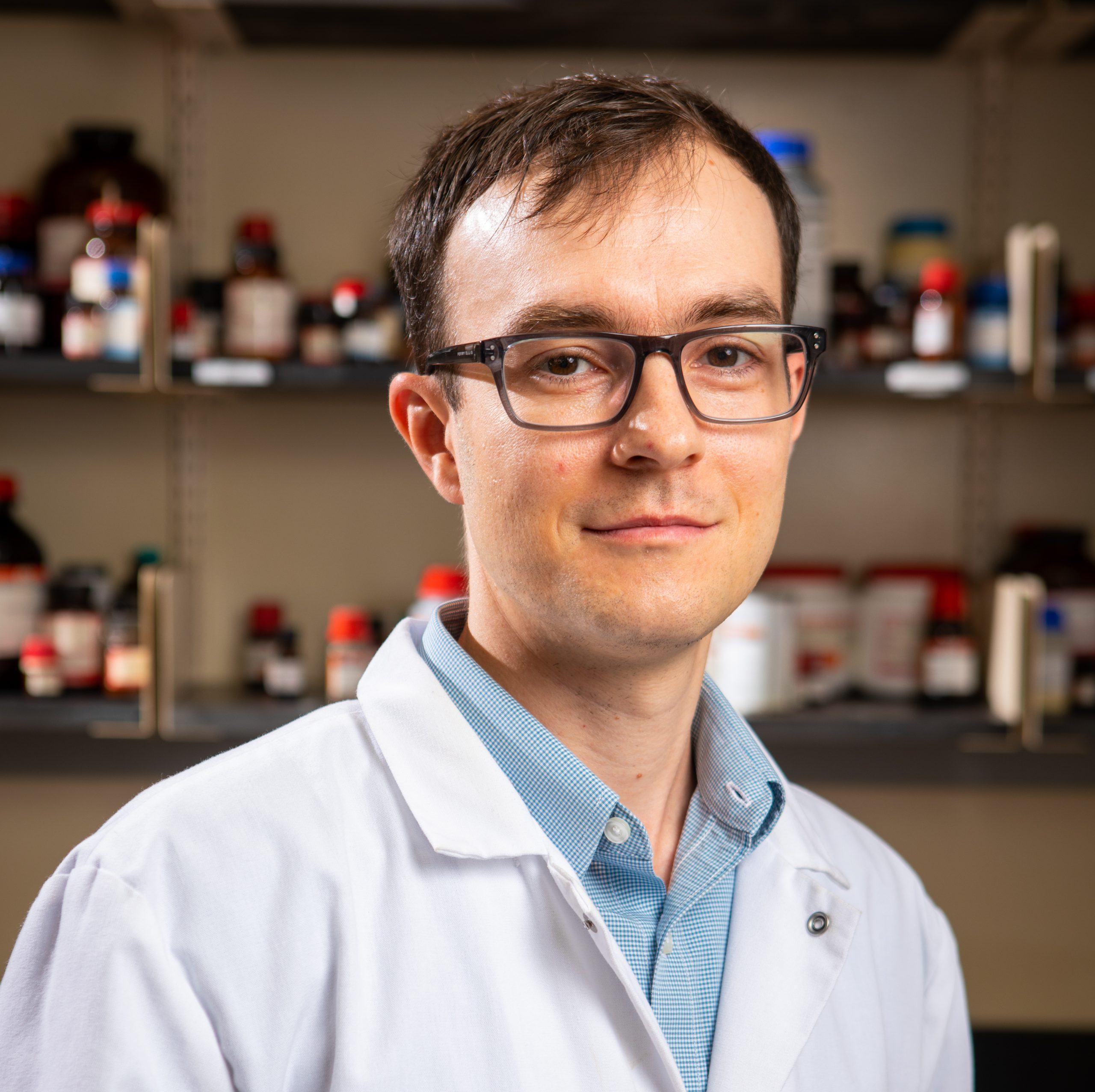
Education and Employment:
B.S. Colorado State University 2007
PhD University of California Irvine 2012
Postdoctoral Studies Caltech 2012-2015
Assistant Professor UB 2015-2021
Associate Professor UB 2021-present
Personal Bio:
When David was about five years old, he wondered a lot about chemicals: what are they, and why is everyone so afraid of them? Fear breeds fascination and once he learned about the periodic table of elements in the fifth grade, it was atoms all the way down from there on out. As he exhausted the local library’s chemical literature, a new question emerged in his mind—how do chemists combine atoms with purpose? Posing this query to his junior high school science teacher, who happened to be a chemist, earned a long pause before she said, “you’d need a PhD in chemistry to know the answer to that question.”
So, after graduating from Colorado State University, that’s what David set out to do. Off he went to UC Irvine where he obtained a PhD in chemistry, learning about how metal atoms get bound up by proteins, and the roles they play in living things in a field called bioinorganic chemistry. He spent a few years at Caltech where he learned to join carbon to metal, a discipline called organometallic chemistry. During these formative years, he came across an esoteric oddity: MnCl3, a binary metal-halide compound, is missing even though its two neighbors CrCl3 and FeCl3 are perfectly stable and genuinely useful. Why is this?
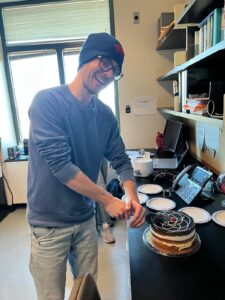
He brought that question with him to the University at Buffalo and began pursuing this and other curious observations. Some of the biggest payoffs have been discovering a new class of compounds, a new elementary reaction that gives unprecedented access to unusual intermediates, and a functional explanation for the unsolved mechanism of how Mn(III) in nature degrades lignin.
Students who join Professor Lacy in pondering the arcane corners of inorganic chemistry learn useful skills in synthetic chemistry and go on to work in the defense, chemical, and semiconductor industries. Meanwhile, Professor Lacy keeps wondering about MnCl3 and how to make it. He supposes that sometimes, even a PhD in chemistry isn’t quite enough.
Awards:
• UB’s Exceptional Scholar – Young Investigator Award, 2020
• Arthur E. Martell Early Career Researcher Prize, 2020
• NSF CAREER Award, 2019
• ACS Petroleum Research Foundation, Doctoral New Investigator Grant, 2017
• NIH Ruth L. Kirschstein National Research Service Award, 2013
• Colorado State University, Chem. Dept. Undergraduate Research Award, 2007
Contact:
359 Natural Science Complex
University at Buffalo, Chemistry Department
Amherst NY, 14260-3000
email: dclacy at buffalo edu
UB Chem. Dept. Link
Google Scholar
Office: 657 NSC
Phone: (716) 645-4114