

Political extremism is often attributed to voter anger and broader structural socioeconomic conditions. From this perspective, efforts to counter extremist movements may appear futile, since such groups are seen as deeply embedded in the contexts from which they arise. But is this necessarily the case? To address this question, we examine the Papal condemnation of an influential far-right movement in interwar France.
1926: The Papal condemnation of L’Action Française (AF)
L’Action Française, a monarchist, nationalist, and anti-democratic movement founded in 1899, following the Dreyfus affair, became one of the most influential organizations of the French Right, establishing deep ties to conservative Catholic circles, attracting practicing Catholics, and enjoying considerable influence among parts of the clergy. Catholic authorities were, however, displeased with AF’s instrumental use of religion and its doctrine of “integral nationalism,” which placed the nation above moral law.
Although the Vatican had decided as early as 1914 to condemn the writings of Maurras, AF’s main leader, as well as the newspaper L’Action Française, that decision was delayed by World War I. Pope Pius XI eventually made that condemnation public in 1927. Catholics who defied it were to be denied any Church sacraments, including communion and burial rites.
Our study documents how the Vatican ban and its effect on decoupling allegiances between Catholics and AF shaped the latter and, more generally, the political right in interwar France.
Elites can fight political extremism.
Using the yearbooks of L’Action Française, we have tracked the development of the League Action Française, coordinated the movement’s propaganda, before and after the condemnation. The papal condemnation had two effects. It halted the League’s development (Figure 1). While the movement enjoyed continuous growth before the condemnation, the number of branches stagnated afterward.
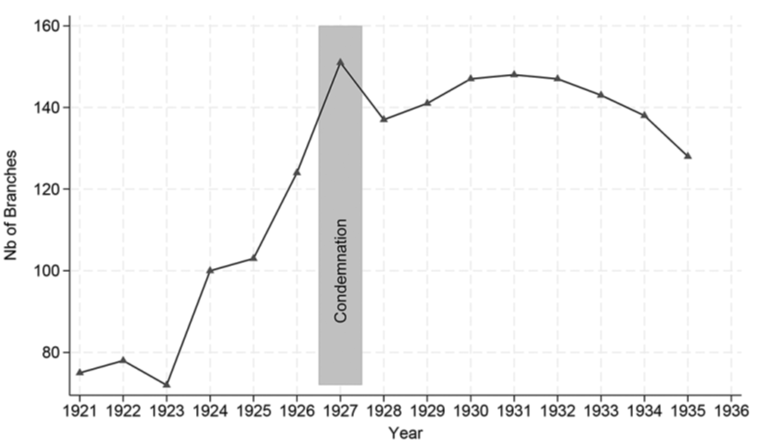
Figure 1: Number of Branches of the League d’Action Française over time
In addition to this blow for the movement, the condemnation arguably led AF to reorganize, shifting its spatial basis of support and its internal structure. The movement’s geography changed after the condemnation (Figure 2). L’Action Française expanded into areas with fewer practicing Catholics, developing a more secular base. The movement attracted opponents to the Church, especially where bishops enforced the Vatican line more aggressively.
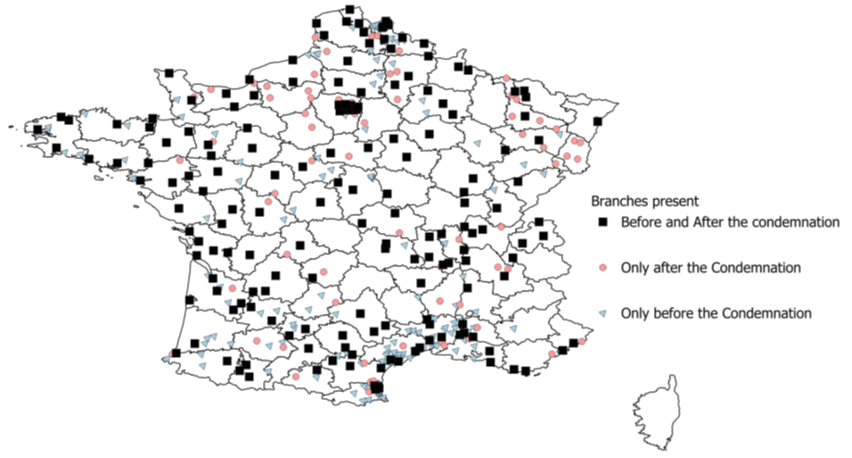
Figure 2: Geography of the League d’Action Française: Before and After the condemnation.
The number of public meetings plummeted. The League also developed smaller and less public sections at the expense of branches with permanent premises. L’Action Française moved away from open, socially embedded activism toward a more discreet and harder-to-monitor organizational form.
The consequences of a new divide
The papal intervention did not simply discipline the Catholic Right. The condemnation opened space for a more democratic Catholic politics on one side, while L’Action Française drifted further into anti-parliamentarian extremism on the other. The condemnation not only affected the movement’s base but also its political actions. Branches created after the condemnation differed from those created before the condemnation. Before the condemnation, the geography of branches of L’Action Française predicts weaker electoral support for the extreme right at the end of the 1930’s. By contrast, the places where new branches sprang up were associated with higher far-right vote shares and experienced more political violence during the 1930’s than the rest of France. In short, the Papal intervention affected the Catholic base of L’Action Française.
How did L’Action Française attract new followers beyond its Catholic base to renew itself? The random timing of bishops’ appointments helps us answer this question. Because bishops were appointed when their predecessors died, the availability of a bishop position in a given diocese at a given time can be treated as random. This variation matters because bishops appointed under the more progressive pontificates of Leo XIII and Pius XI enforced the condemnation more rigorously. Yet stricter enforcement also generated a backlash, attracting new followers opposed to both the condemnation and the Church more broadly. The condemnation thus not only fractured the movement’s original base but also contributed to its recomposition along a new political-religious divide.
Elite’s condemnation – What to expect?
Our results temper the role of structural factors in explaining the success of some extremist movements. Although the settlement that followed World War I, the inflation of the 1920s, and the economic crisis of the early 1930s resulted in the rise of political polarization and democratic breakdowns, elites still had some room to maneuver. Structural factors did not mechanically produce the same outcomes everywhere, partly because of the choices made by influential institutions and leaders. In some instances, influential actors have used their power to mediate the effect of those structural factors. In France, the Catholic Church used its authority and organizational reach to discipline part of the Right. That intervention did not save French democracy on its own, but it helped deprive one important reactionary movement of considerable Catholic support.
These findings also highlight a larger point about the forces that shape politics. Political structures are not determined only by parties, elections, and public opinion. They can also be influenced by institutions that operate outside formal politics but still have deep roots in society. Religious organizations are one important example. They often possess loyal communities, moral authority, and strong organizational networks, which can give them real power to influence how people think, align, and act politically. More broadly, that suggests that many actors beyond the state or party system can play a significant role in structuring political life. Politics, in other words, is often shaped not just by what voters want, but also by which institutions have the authority, reach, and capacity to organize people around particular ideas and interests. Rising polarization and extremism may also result from the inactivity of these powerful actors.
Carles Boix and Jean Lacroix
https://www.journals.uchicago.edu/doi/abs/10.1086/736028?journalCode=jop