
Discovering and understanding materials for energy and chemical technologies increasingly requires navigating enormous spaces of compositions, structures, interfaces, and operating conditions. Our group develops physics-grounded AI and modeling approaches to make this search more efficient while retaining the physical and chemical understanding needed for reliable materials design.
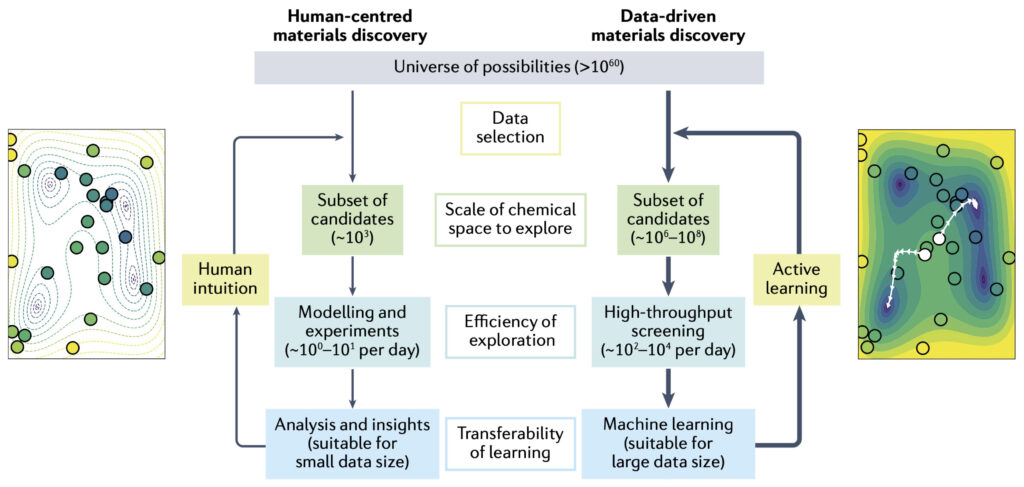
We work at the intersection of materials physics, surface chemistry, atomistic simulation, and AI. Our research combines first-principles calculations and statistical-mechanical modeling with machine learning, such as graph neural networks, machine-learning interatomic potentials, generative models, active learning, and emerging agentic AI. A central goal is to move beyond black-box property prediction toward AI approaches that can reveal physical principles, quantify uncertainty, guide simulations and experiments, and ultimately support scientific decision-making.
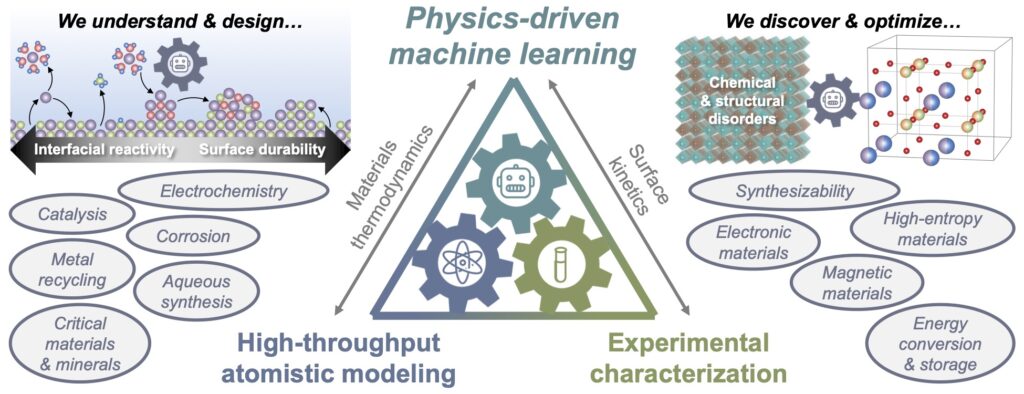
Our research spans several interconnected directions. We develop AI-enabled atomistic models of electronic structure and chemical reactivity to understand how local composition, bonding, and atomic environments govern catalytic and materials properties. We study dynamic surfaces and interfaces, such as stability, reconstruction, and the evolution of active-site ensembles under realistic operating conditions, where the relevant material may differ substantially from an idealized static structure. These themes build on the group’s work connecting atomistic simulations and data-driven approaches to the thermodynamics and kinetics of catalyst degradation and surface restructuring.

A growing focus of our group is chemical disorder and compositionally complex materials. Rather than treating disorder as an imperfection to be averaged away, we seek to understand how chemical ordering, local correlations, defects, and configurational ensembles influence materials properties. We develop disorder-aware and disorder-native AI approaches that connect atomistic representations with statistical mechanics and experimental observables, with applications spanning alloys, oxides, high-entropy materials, and reactive interfaces.

We are also exploring AI-driven scientific discovery workflows that connect computation more directly with experiments. Working closely with collaborators, we develop materials-centric agentic AI that integrates physics-based modeling, multimodal characterization data, and uncertainty-aware active learning and decision-making. Our goal is to enable closed-loop workflows in which simulations and experiments iteratively inform one another, extending materials discovery from brute-force, black-box screening toward increasingly reasoning-enabled and autonomous approaches.

Across these directions, our broader goal is to develop materials-centric AI that is physically interpretable, experimentally grounded, and useful for discovering actionable scientific principles—not simply faster prediction models.