

An image problem
For international courts to function effectively, they require the support of citizens in the countries they investigate. Sometimes, this support is easily attained, as seen when Ukrainians celebrate the International Criminal Court’s (ICC) actions against Russia. Other times, the accused and their allies actively campaign against the ICC, such as when Israeli officials decry it as illegitimate and the United States places Court officials on sanctions lists that are usually reserved for drug kingpins and terrorists.
To garner public support, international organizations like the ICC must convince people to support them. The ICC relies heavily on the idea that they are a “court of last resort” to persuade potential supporters. The Court only investigates when the country in question is “unwilling or unable” to do so for itself. This design feature of the Court is referred to as complementarity in legalese. It is intended to reassure citizens that the Court is not an over-aggressive, hegemonic, or imperial body that intervenes arbitrarily. When it does act, it has only done so after respectful deference to local authorities. Complementarity is also an implicit threat. It advises countries that could fall under ICC scrutiny to act, or else the Court might intervene. This hopefully spurs domestic bodies to conduct themselves.
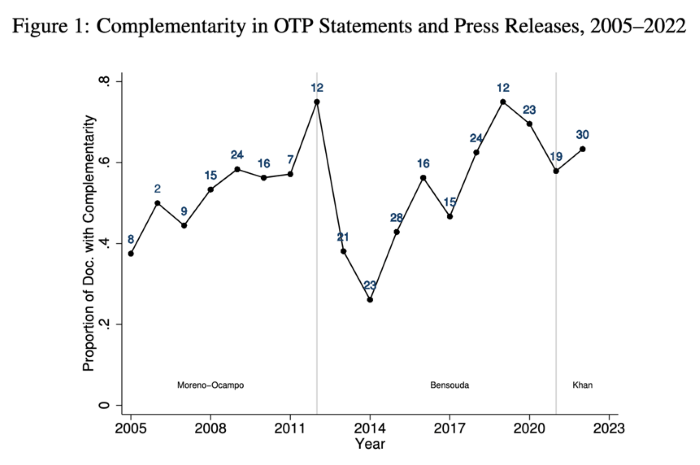
In our analysis of press releases and statements from the ICC, the rhetorical emphasis on complementarity has increased over time. By 2022, over 60% of these documents mentioned the concept of complementarity.
Support the Court of Last Resort?
Our research suggests that this rhetorical appeal is not effective. We surveyed over 10,000 citizens in Georgia, the Philippines, Israel, South Africa, and the United States. This is a diverse slate of countries, from different regions, with other past experiences with the Court. In our surveys, we randomly assigned respondents to get a prompt about the Court that did or did not include additional information about complementarity. The additional information mimicked the typical mentions of complementarity found in newspaper articles or Court statements. We then asked respondents about their support for the Court and their support for their country’s own domestic investigations into any allegations.
In most countries, appeals to complementarity had near-zero or even negative effects on support for the Court and support for domestic investigations. This surprised us because complementarity is one of the most prominent messages the Court conveys about itself.
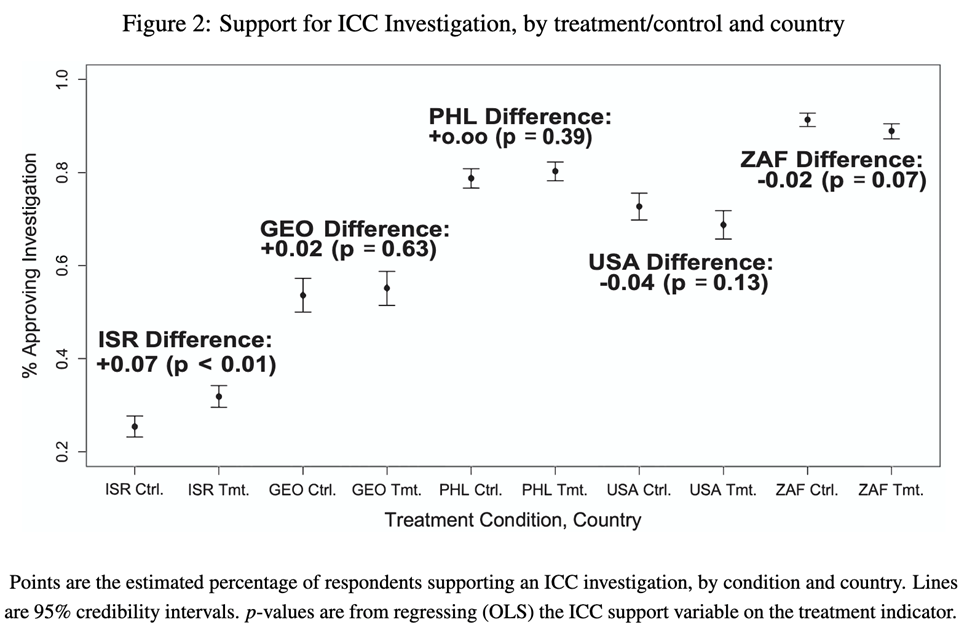
We reproduced the main results in the Figure below. For each country, the dot-and-whisker plot shows the percentage of people who approve of an ICC investigation for that country. Comparing the values for the respondents who received the treatment (“Tmt.” In the figure) and respondents who were assigned to the control group (“Ctrl.”) shows the effect of our prompt about complementarity. For example, in Israel, the complementarity treatment raised the percentage of people who approved an ICC investigation from 25% to 32%. In the United States, information about complementarity decreased support for an ICC investigation from 73% to 69%. There were minimal effects in Georgia and the Philippines. In South Africa, complementarity also decreased approval of the ICC, by 2%.
Why complementarity doesn’t persuade and why this matters
Every country’s situation is unique, and opinions vary widely within countries, but there are common threads. Even though complementarity serves as a guardrail against an interventionist Court, the ICC itself still makes the final decision regarding the adequacy of local investigations. The Court itself determines whether it can act, so many respondents view complementarity as a superficial check on the Court’s authority. To act, the Court must also make a negative judgment about the country in question, which often raises the hackles of many people.
This matters because international organizations face a significant challenge. The United States’ recent turn away from the liberal international order has made it critical for international organizations to find ways to cultivate support. It’s helpful to know what type of messaging doesn’t work so that we can focus more on alternatives.
Complementarity in Israel
The ICC investigation into alleged crimes committed by Palestinians and Israelis makes it especially important to understand how Israelis think about the Court. In our surveys, Israeli respondents were the most persuaded by appeals to complementarity. They had some of the lowest initial levels of support for the Court. However, mentions of complementarity increased their support for the Court by an average of 7%. They also increased support for domestic investigations by 6%.
We fielded our surveys in 2019 and 2021, before the October 7th Hamas attacks and subsequent retaliation in Gaza. We asked respondents about complementarity with respect to allegations about West Bank settlements and not about the use of force in Gaza. At the time, many legal experts thought Israel had a strong defense against allegations about Gaza, because the Israeli Defense Force extensively scrutinized Israeli uses of force in Gaza. Some commentators argued against stripping the Israeli Supreme Court of its authority because doing so would further weaken Israel’s ability to claim that it had adequately investigated allegations on its own, therefore increasing Israeli exposure to the ICC.
The extreme violence on and after October 7th has made the ICC less relevant in the minds of many. People everywhere worry less about international law and norms when they face existential crises. We would expect that this makes it even harder for an international organization to appeal to its design features or deference to national authorities to garner support.
Authors
Kelebogile Zvobgo and Stephen Chaudoin