
Instructor: Nick Bruscia
ARC 605
Fall 2023, 2024, 2025
Fidelity – the degree of exactness with which something is copied or reproduced, and/or, the degree to which a model or simulation reproduces the state and behavior of a real-world object, feature, or condition
Tolerance – an allowable amount of variation of a specified quantity, and/or, the ability or willingness to tolerate something, in particular [technologies and techniques] that one does not necessarily [align] with
DESCRIPTION:
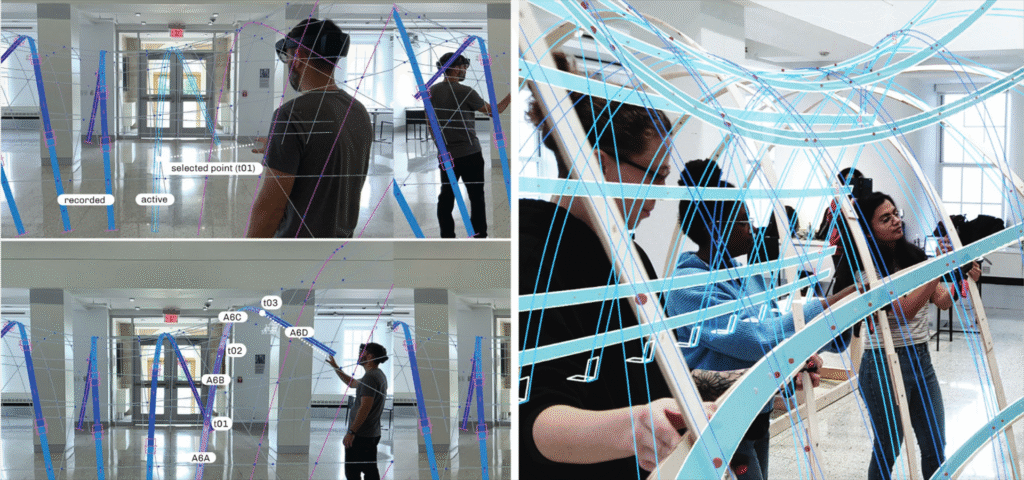
This studio examines both the potential and the limitations of integrating mixed reality (MR) into established forms of handwork across contexts such as local craft, manufacturing workflow, and material production. MR overlays digital information onto the physical environment, producing a composite view that blends real and virtual elements.
Student work will focus on bridging manual and digital ways of knowing through MR-based visualization and fabrication workflow. As MR gains momentum in academic research and professional practice, supporting architectural design as well as construction on and off-site, it emerges as a natural extension of digital modeling proficiency. Having already reshaped the AEC industry, MR introduces a new educational paradigm at a moment when fluency in computational tools is becoming increasingly essential.
The studio frames its inquiry around the concepts of ‘fidelity’ and ‘tolerance,’ considering how digital technologies interact with handcraft and tacit knowledge. Within this lens, MR functions as a ‘situated technology’—not simply a collection of machines, devices, or software, but a set of relationships among tools, people, and fields of expertise. The aim is not to replace or surpass the handwork of trades, but to foster a more reciprocal dialogue between design and production, and between representation and realization. This approach also acknowledges the epistemological significance of informal technological knowledge.
The influence of technical arts on architectural traditions continues today, reshaped by the accessibility of advanced digital tools and fabrication equipment. For students, this studio offers a framework to critically and creatively engage with these shifts— developing technical proficiency, cultivating design agility, and gaining insight into the evolving relationship between tools, materials, and architectural practice. In doing so, it emphasizes architectural research not only as a disciplinary pursuit, but as a means of preparing future practitioners to navigate and contribute to an increasingly dynamic and unpredictable environment.